
In general, what helps your local business get visible in Google is what helps it get visible in the local AI results. There’s a lot of overlap. One corollary is that when you’re not visible in one arena, you’re probably not visible in the others, either. Maybe you don’t even want or need to show up everywhere, but you do need to get some points on the board. That would be good for business.
There’s a practical, low-tech way you can get a foothold in the local AI results, starting today. It’s a clever, yet natural, extension of the strategy I laid out in my 2025 post titled “Easy Win for AI Local SEO: a Strong “Why Choose Us” Page on Your Site.” The blog post below describes and shows the extended version of that strategy in detail. It’s a guest post by Avner Dachoach, the owner of Top Rank Scout. I’ve gotten to know Avner over the past couple of years, and he’s a skilled and resourceful local SEO. He works with clients (many of whom are in Florida) in a range of industries, and has used this strategy to produce very solid visibility for them in the local AI results.
Below is Avner’s strategy, in his words and with images he provided. (I have not made a single edit.) Please leave a comment if you have a question or anything to share. Enjoy!
SEO takes a while to show results. A big reason is diminishing returns: climbing from the middle of page one into the top 1-3 spots is much harder than getting onto the page in the first place. And those top spots are where the traffic is. According to First Page Sage’s 2026 click-through data, the top 3 organic results capture 77.1% of organic clicks, and the click curve flattens out below position 5.
AI works differently. Google ranks results. AI chooses them. As long as AI finds you somewhere, and you clearly meet the criteria it (and the searcher) cares about, you can be the one it picks. The best way to get AI to like you more is to find out what it already likes, and make sure you obviously have it.
How AI thinks
When someone asks AI for a recommendation, it works in two stages. First, it gathers a small pool of candidates. It runs a few searches and reads a handful of pages, because it isn’t going to look up every plumber in Augusta. Then it chooses from that pool and explains why.
In my experience, AI is “satisficing”: it looks for an answer that’s good enough with the least effort. In the choosing stage, that means it leans toward the business that’s easiest to justify, the one whose page clearly states the reasons AI already looks for, so it doesn’t have to dig or guess. If your page covers more of those reasons than anyone else in the pool, and backs them up with a few unique advantages AI can repeat to the searcher (for example, “This lawyer is a former prosecutor”), you make it much easier for AI to pick you. You’ve given it an A+ answer to the searcher’s question and saved it the effort of digging any further, and it rewards you for it.
Getting into the pool is the harder part, and it still takes good SEO. But AI’s pool reaches deeper than Google’s top results. In the examples below, ranking on Google’s second page was enough to get considered. So the real focus should be on becoming the obvious pick once you’re in.
Work backward from what AI already rewards
Instead of starting with your unique advantages (we’ll come back to those later), it’s better to build on what AI already picks. If you already know what it likes, why reinvent the wheel?
Researchers study any skill this way. Anders Ericsson, whose work inspired the “10,000-hour rule,” studied top performers and worked backward. In AI search, the top performers are the businesses it recommends again and again, and its reasons for choosing them show you exactly what to emulate.
The process
Step 1: Ask AI directly. I keep the prompt simple:
“Who are the best [profession] in [city]? Tell me the reasons for each pick.”
Run that in about 15 populous US cities and you’ll cover all the reasons AI cares about. Top businesses in different cities get picked for different reasons, so none of them has every reason. If you have all of them, you’ll check more of AI’s boxes than any one of those top competitors. That makes you more than another top option. It makes you irresistible.
Step 2: Combine the reasons and fill the gaps. I merge the reasons from every city, then mix in the top reasons from industry research and from the best competitors’ reviews (an AI browser extension can collect all the reviews from a handful of competitors in a few minutes). That catches anything AI missed, and it makes sure the page converts human visitors too, not just AI.
Step 3: Add your own unique advantages. Now that you know which reasons matter, this is the perfect place to add what makes you different. Attach each advantage to the reason it proves. A book you’ve written goes under expertise. A federal case you co-chaired goes under experience or results. That way your page is both thorough and unique. You cover every reason AI looks for, and your advantages give it a specific reason to pick you over businesses that check the same boxes. Instead of “an expert,” AI can tell the searcher “an expert who created a series of courses on the subject.”
Step 4: Build a “why choose me” list and use it on every page. What I end up with is a big list of reasons to choose the business, ranked from most to least important. I add it to my project file in AI and use it when writing service pages, picking the reasons that fit each service and covering them in that order. The most important reasons come first, where both readers and AI see them right away, so the strongest case for choosing you is never buried halfway down the page.
The result: I can get clients leads from AI well before they rank well on Google. They might be the 14th business AI found, but once it finds them, they’re irresistible, because the page was designed to be from the start.
Example 1: An adult ADHD counselor in Plantation, Florida
I built this client’s ADHD therapy page directly from ChatGPT’s answer when I asked what qualities, qualifications and experience matter most in a counselor who specializes in adult ADHD.
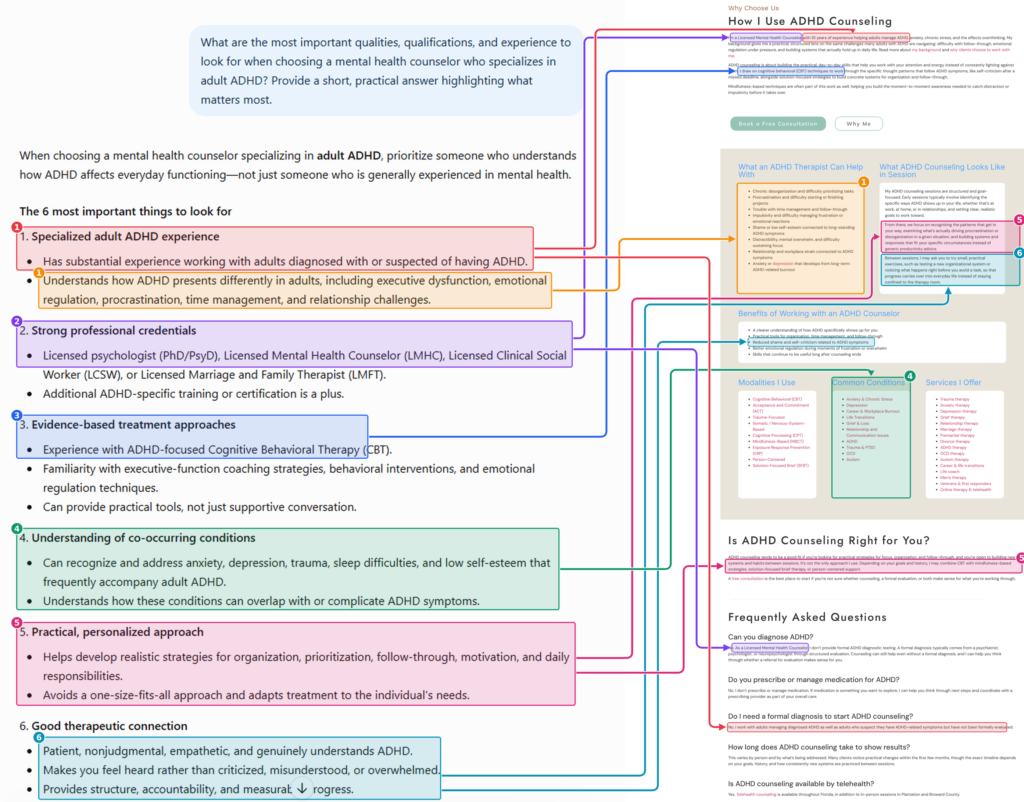
Note: this is a simplified version of the prompts. The best move is to compare the reasons across multiple cities (and multiple AI engines) and combine them.
The result: the client consistently ranks #1 in ChatGPT for an adult ADHD counselor in Plantation, despite not showing up on Google’s first page.
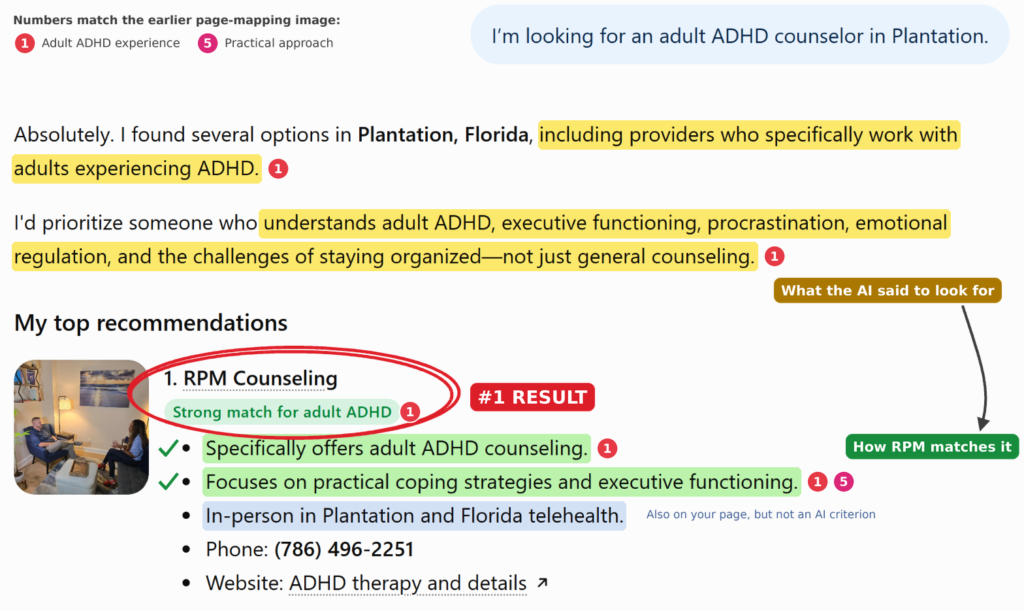
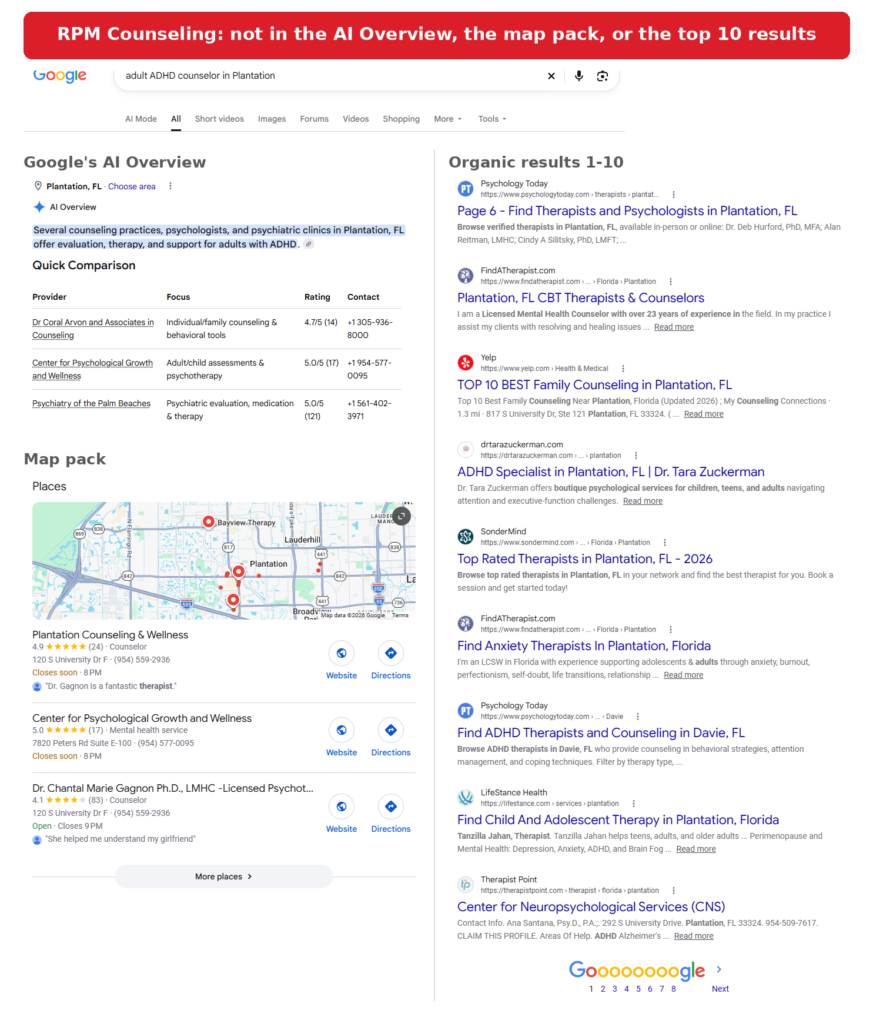
Here’s the same search on Google. RPM doesn’t show up anywhere on the first page: not in the AI Overview, not in the map pack, and not in the 10 organic results.
Example 2: An industrial epoxy contractor in Hollywood, Florida
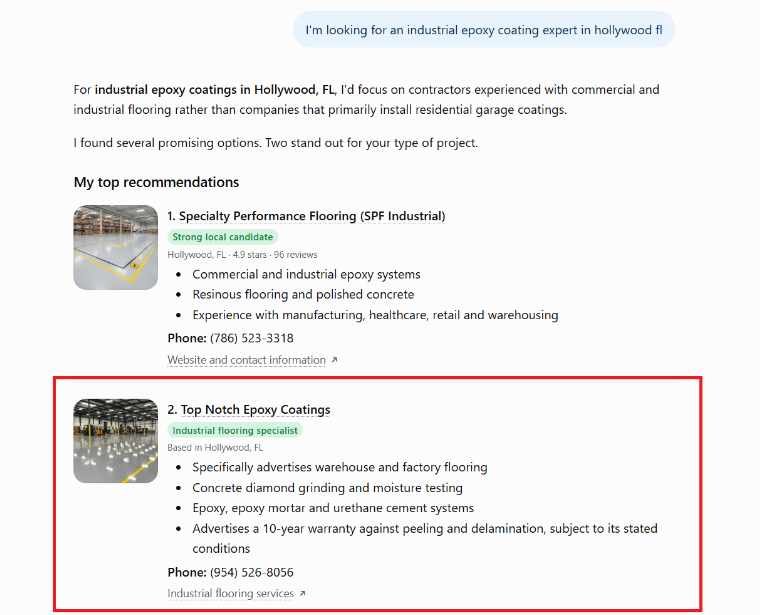
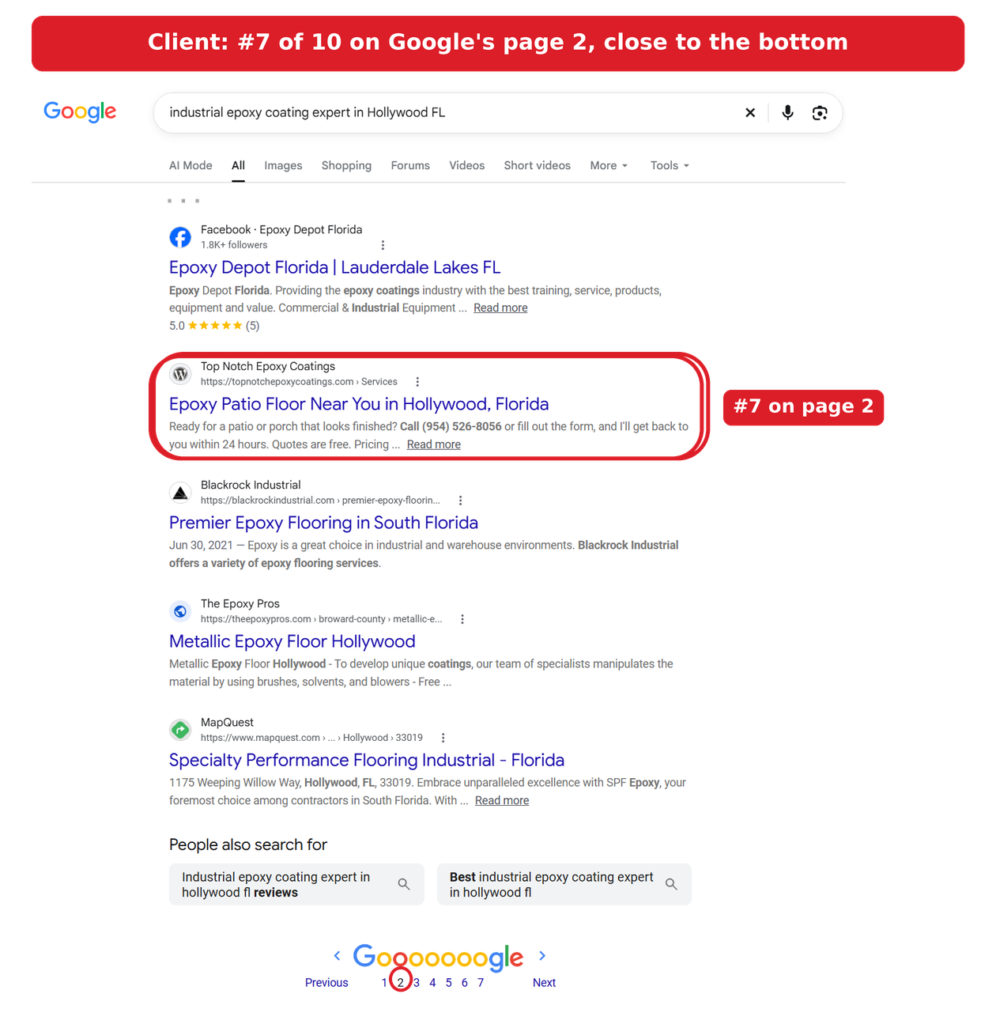
This one is even more extreme. I’ve worked with this client for one month. On Google, they don’t show up on page 1 at all, and their first result is close to the bottom of page 2. Even that result is their patio page, not their industrial flooring page. ChatGPT already recommends them for industrial work anyway.
You don’t have to wait to see results
Getting into AI’s pool of candidates can take time, especially for a newer or smaller business. But you don’t have to wait to find out whether your page will win once it’s there. You can skip the gathering stage: give AI your site directly and have it compare you against the top competitors.
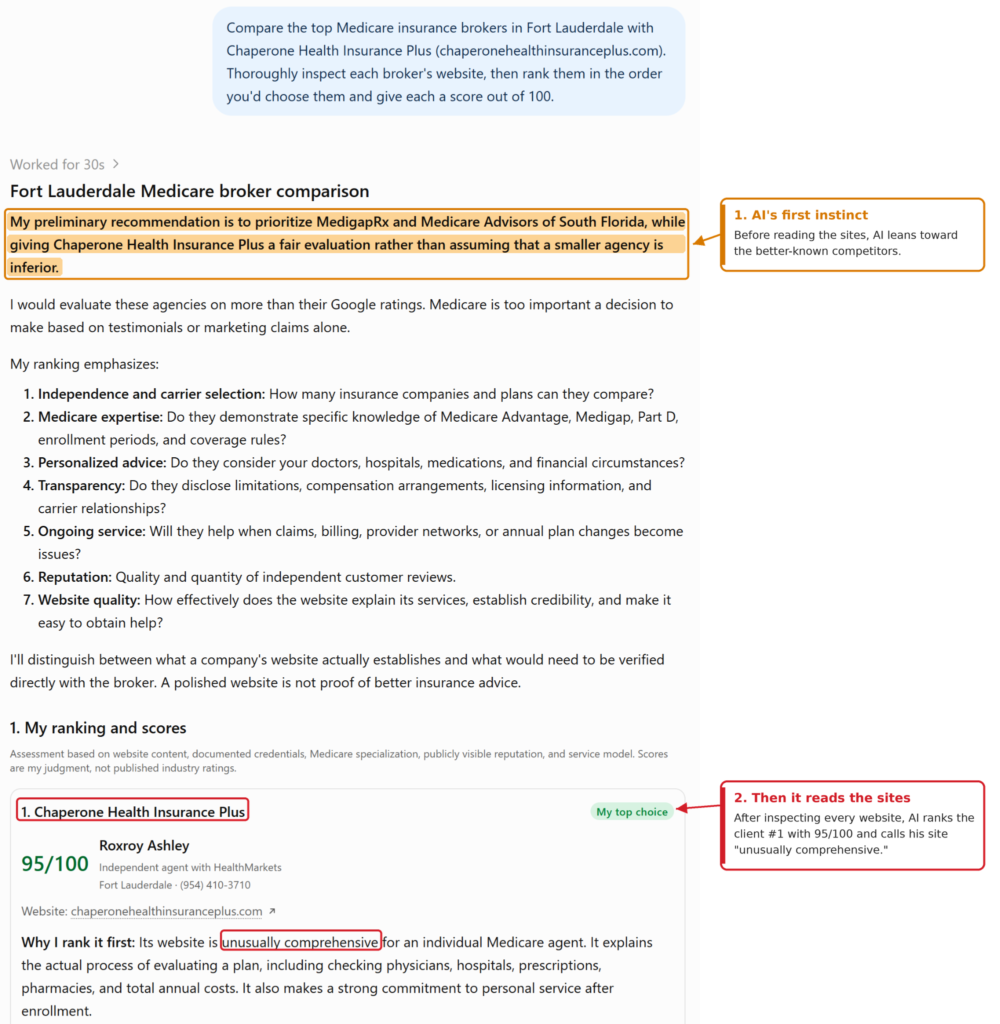
The client below is a Medicare insurance agent in Fort Lauderdale. He doesn’t rank well enough yet to show up in AI recommendations on his own. But when I asked ChatGPT to inspect his website alongside the top brokers in the area, it ranked him first with a score of 95/100. It even started out expecting to prefer two of the bigger agencies, then changed its mind after reading the sites, calling his “unusually comprehensive” for an individual agent.
That tells me the page is doing its job. Once he’s visible enough to be considered, he’s in a strong position to get picked.
Bonus: Put everything in one spreadsheet
More recently, I’ve been taking this a step further and combining every source into one spreadsheet. Each row is a reason customers choose a business. The columns show how much that reason matters in each source: industry research, review mentions, competitors, how often AI brought it up across the city answers, and my own evaluation. A combined score ranks the reasons from most to least important.
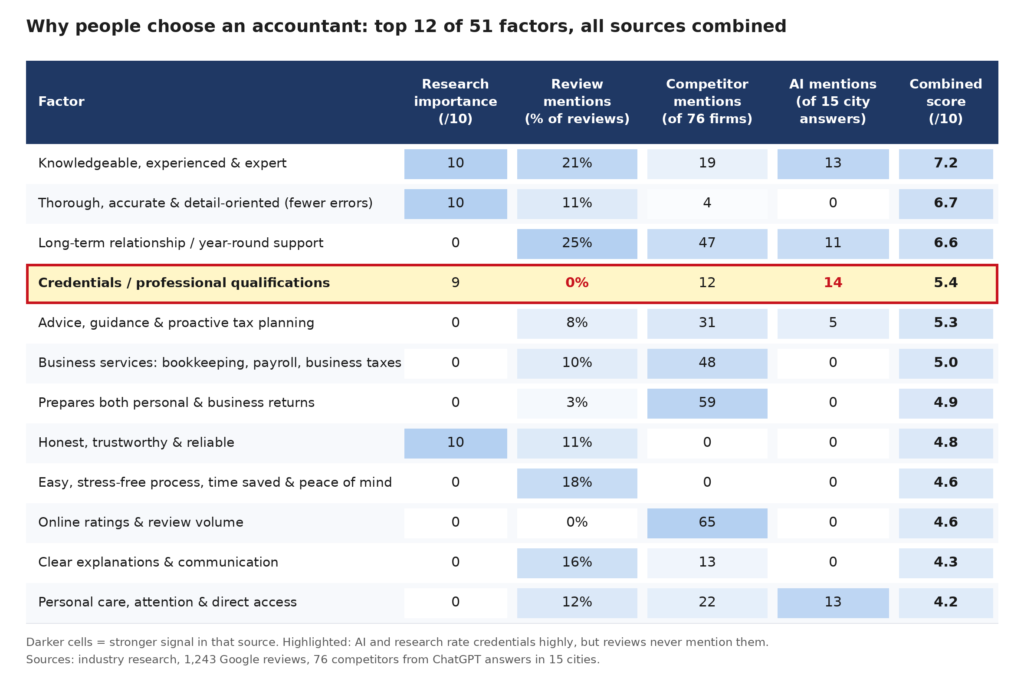
Laying it out this way gives me a much clearer picture than any single source can. Ericsson called this kind of picture a mental representation, and it’s how experts see patterns that others miss. It shows where the sources disagree. In the example above for an accountant, AI brought up credentials in 14 of its 15 city answers, and research found people choose credentialed preparers more often. Yet not one of 1,243 customer reviews mentions credentials. If I had only read reviews, I would have left out one of the strongest reasons people choose an accountant.
A clear picture also lets me make human decisions instead of just following the numbers. The spreadsheet tells me what each source thinks. Once I know a client and their industry well, I can override that or reprioritize certain reasons when my experience tells me something the data can’t.
Try it yourself
- Ask AI for the best businesses like yours in several cities, and ask it to explain each pick.
- Combine its reasons with industry research and your best competitors’ reviews.
- Attach your unique advantages to the reasons they prove.
- Build each service page around the reasons that fit that service, most important first.
You don’t have to wait for Google to start sending you leads. Give AI exactly what it’s looking for, and it can start recommending you now.
About the author: Avner Dachoach is the owner of Top Rank Scout, where he helps local businesses get found and chosen in both Google and AI search.
Great stuff! AI feels like it’s a just a fast researcher who spots patterns. Thanks for the tips.
Phil you are always bringing in good workable insights that I can use right away. Appreciate you!
Thanks a lot, Robin! I can’t take much credit for the strategy.
Yeah, when used effectively AI is a forklift for the mind, to paraphrase Steve Jobs.